
What is a cenote?
A cenote (pronounced seh-NO-tay) is a natural sinkhole formed when limestone rock collapses and exposes the groundwater beneath. Most are found on Mexico's Yucatán Peninsula.
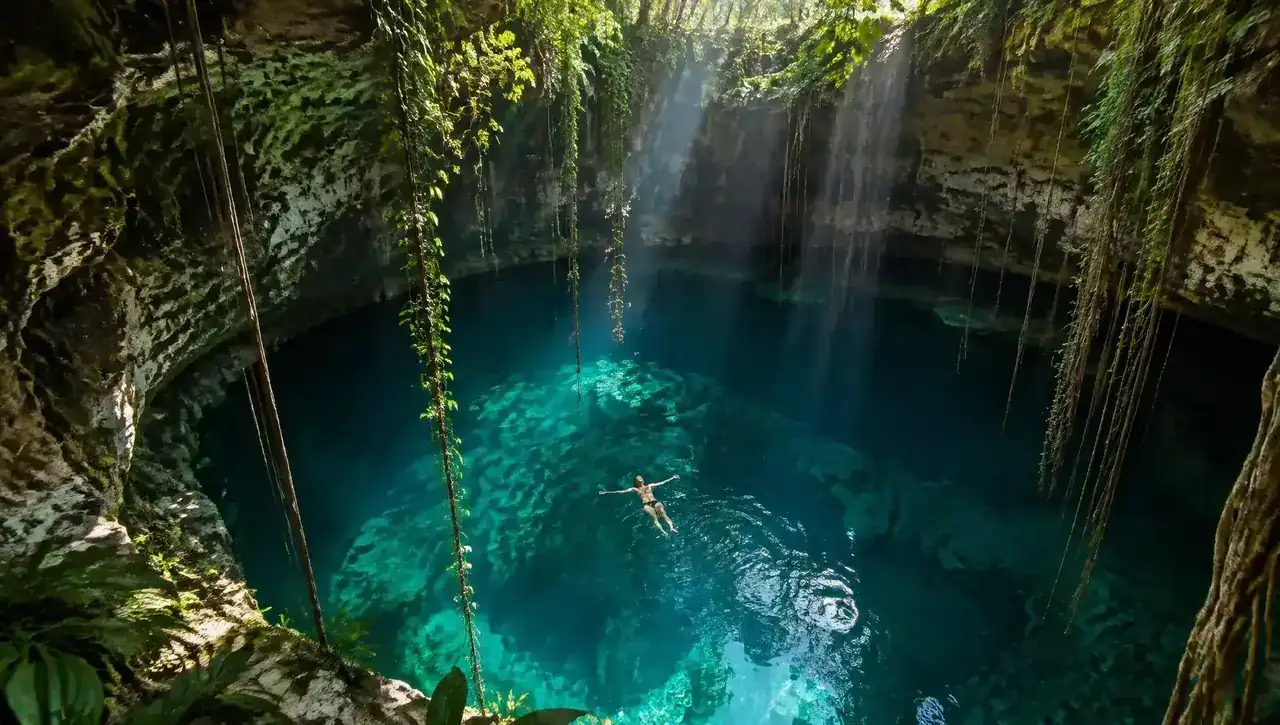
Cenote meaning
The word comes from the Yucatec Maya ts'onot, meaning a well or hole with water. The Spanish adapted it to "cenote", and English borrowed the Spanish word, so it means the same in English and Spanish: a natural water-filled sinkhole.
What is a cenote in Mexico?
In Mexico, "cenote" usually means one of the thousands of freshwater sinkholes on the Yucatán Peninsula, in Quintana Roo, Yucatán and Campeche. Many are now swimming spots near Cancun, Tulum, Playa del Carmen, Mérida and Valladolid. See cenotes in Mexico for where they are.
How are cenotes formed?
The Yucatán Peninsula is a flat shelf of porous limestone. Over thousands of years, slightly acidic rainwater dissolved the rock and carved underground rivers and caves. When a cave roof collapses, the water below is exposed and a cenote is born.
Many cenotes in Yucatán form an arc called the Ring of Cenotes, which scientists link to the edge of the Chicxulub impact crater.
Types of cenotes
- Cave cenotes: mostly underground, reached through a small opening.
- Semi-open cenotes: partly covered by a rock ceiling.
- Open cenotes: fully exposed to the sky, like a jungle lake.
- Ancient cenotes: old open cenotes slowly turning into shallow lagoons.
How deep is a cenote?
Depth varies a lot. Swimming areas are often only a few meters deep, many cenotes reach tens of meters, and the deepest known water-filled sinkhole, El Zacatón in northeastern Mexico, has been explored past 300 m. See how deep cenotes are.
Why cenotes matter: the water underground
The Yucatán Peninsula has almost no rivers on the surface. Rain soaks straight through the limestone and refills a vast underground aquifer, and cenotes are the places where that water shows. That is why they were the Maya's main water source, and why pollution in one cenote can affect water far away. Learn more about the Yucatán aquifer and what lives in cenotes.
Cenotes and the Maya
Cenotes were the main source of fresh water for the Maya. They were also sacred: seen as entrances to Xibalba, the underworld. The Sacred Cenote at Chichén Itzá received offerings including jade, gold and human remains. Read more in the Maya and cenotes.
What can you do in a cenote?
- Swim and float in clear fresh water
- Snorkel among rock formations and fish
- Cavern and cave dive with certified guides
- Jump from platforms where allowed
Rules and safety
- Shower before entering and skip regular sunscreen or repellent.
- Wear a life jacket if you are not a confident swimmer.
- Never enter caves without a certified guide.
Where to see cenotes
- Best cenotes in Tulum: Gran Cenote, Dos Ojos and more
- Cenotes near Cancun
- Ruta de los Cenotes near Puerto Morelos
Go deeper: cenote science
- How are cenotes formed
- Types of cenotes
- The Ring of Cenotes
- Chicxulub crater and cenotes
- Halocline in cenotes
- Cenote vs sinkhole
- Why is cenote water so clear
- How deep are cenotes
- Sac Actun underwater cave
- The Yucatán aquifer
- Stalactites in cenotes
- Cenote wildlife
Frequently asked questions
How do you pronounce cenote?
In English it is usually said seh-NO-tay.
What does the word cenote mean?
It comes from the Yucatec Maya word ts'onot, meaning a well or hole with water.
Are cenotes safe to swim in?
Public cenotes are generally safe when you follow the rules: wear a life jacket if you are not a strong swimmer, never dive into unknown water and only enter caves with a certified guide.
What is at the bottom of a cenote?
Usually limestone rock, fallen trees and sediment. In some cenotes archaeologists have found Maya offerings, pottery and bones.
Where are most cenotes found?
Most are on Mexico's Yucatán Peninsula, in the states of Yucatán, Quintana Roo and Campeche.